Updates
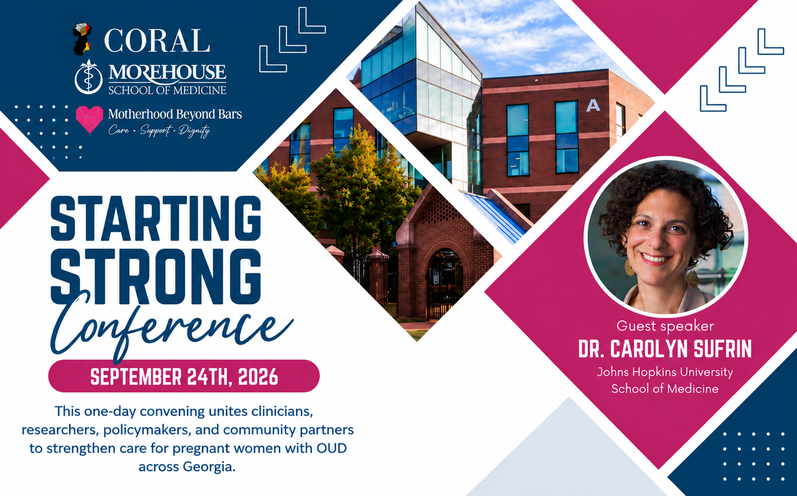
STARTING STRONG 2026 Poster Presentations | SEPTEMBER 24, 2026
Poster sessions: 8:30-9:00 AM and 12:25-1:30PM | Use poster numbers P01-P16 to locate presentations
Poster Focus 1: CLINICAL CARE & SYSTEMS
P01 : Strengthening Systems of Care: Developing and Implementing a Statewide Training Program on Pregnancy and Opioid Use Disorder
Evelina Sterling, PhD, MPH, MCHES | Morehouse School of Medicine
A statewide, multidisciplinary training initiative is being developed to strengthen Georgia's perinatal workforce in opioid use disorder screening and treatment, medications for OUD, trauma-informed care, harm reduction, neonatal considerations, and referral resources. The program aims to improve knowledge, interdisciplinary collaboration, and coordinated, compassionate care for pregnant and postpartum individuals with OUD.
P02: Treatment of Maternal Opioid Use Disorder in Rural Communities: Mapping the Current Evidence
Kaelyn Griffiths | Morehouse School of Medicine
This scoping review examines maternal OUD treatment in rural communities, where geography, workforce shortages, transportation barriers, stigma, punitive policies, and socioeconomic factors can limit access to evidence-based care. Findings emphasize integrated clinical, behavioral, and social services and highlight telehealth, Medicaid expansion, and Plans of Safe Care as promising but inconsistently implemented approaches.
P03: Identifying Cumulative Social Determinants of Health From Clinical Notes: Impact on 90-Day Rehospitalization After Opioid-Related Hospitalization
Syeda Umme Salma | Kennesaw State University
This retrospective cohort study examines whether cumulative adverse social determinants of health are associated with 90-day rehospitalization after opioid-related hospitalization. Patients with two or more documented adverse SDOH domains had substantially higher odds of rehospitalization, underscoring the potential value of SDOH screening, coordinated social services, and timely linkage to addiction treatment.
Poster Focus 2: POLICY, JUSTICE & EQUITY
P04: Decoupling Safety from Surveillance: Reimagining Georgia's Plan of Safe Care for Infants Prenatally Exposed to Opioids
Aisha Burrus
This systems analysis considers how Georgia's implementation of Plans of Safe Care may influence care-seeking among pregnant people with OUD. It proposes a community-centered alternative that connects families with MOUD, behavioral health, housing support, and trusted navigation, reframing Plans of Safe Care around family stabilization, support, and health rather than surveillance and punishment.
P05: Assessing the Reproductive Health Needs of Incarcerated Women in Georgia
Alexis Hernandez, MD, MPH | Emory University
Using a reproductive justice framework and community-based participatory approach, this study examines reproductive healthcare experiences among incarcerated women in Georgia. Findings highlight gaps in gynecologic care and negative healthcare experiences during incarceration, drawing attention to the long-term consequences of reproductive healthcare inequities within the prison system.
P06: Reducing Stigma in Perinatal Substance Use for Justice-Involved Populations
McKenzie Harpe, MPH, CHES | Red Dirt Births, LLC
This initiative focuses on reducing stigma and strengthening prevention for pregnant and postpartum people affected by substance use in justice-involved settings. A proposed needs assessment and educational toolkit address perinatal substance use, harm reduction, postpartum risk, and non-punitive engagement to promote earlier identification, greater trust, and more supportive responses.
Poster Focus 3: FAMILY & RECOVERY SUPPORT:
P07: Reimagining Care for Birthing Parents and Substance-Exposed Newborns
Jada Hoyle-Gardner, PhD | Morehouse College
Project AIME is a patient-centered framework designed to improve care for birthing parents and families of substance-exposed newborns. The approach integrates maternal health, overdose prevention, harm reduction, community engagement, and child-welfare systems while emphasizing provider training, lived experience, supportive resources, and coordinated care centered on families and trust.
P08: Exploration of the Influence of Interpersonal Relationships on Harm Reduction during Pregnancy/Postpartum
Tierra Hollaway, PhD, LMFT | Morehouse School of Medicine
This mixed-methods study explores how interpersonal relationships influence harm-reduction and recovery practices among pregnant and postpartum women with histories of substance use. Findings suggest supportive romantic relationships can facilitate reduced substance use and harm-reduction practices, highlighting the potential value of engaging partners in recovery interventions.
Poster Focus 4: OPIOID EXPOSURE & NEONATAL OUTCOMES
P09: Pre-clinical Studies on the Long-Term Effects of Perigestational Opioid Exposure in Male and Female Rats
Anne Z. Murphy | Georgia State University / Neuroscience Institute
This preclinical research program investigates long-term behavioral and neurobiological consequences of opioid exposure before, during, and after pregnancy. Using a clinically relevant rat model, the work examines reward, social behavior, subsequent fentanyl use, and the effects of social adversity to identify mechanisms that may contribute to later vulnerability and potential intervention targets.
P10: Effects of Perinatal Opioid Exposure on Adolescent Social Behaviors in Male and Female Rats
Rachel Bond, M.S. | Georgia State University
This preclinical study examines lasting changes in adolescent social behavior following perinatal opioid exposure. Morphine-exposed animals showed deficits in social reward, particularly among females, alongside changes in oxytocin and endogenous opioid systems, offering insight into neurobiological pathways that may underlie longer-term behavioral effects of opioid exposure during pregnancy.
Poster Focus 5: MATERNAL HEALTH EQUITY
P11: The Intersection of Place, Race, & MOUD: Associations Between Neighborhood Deprivation, Birth Volumes, and Maternal Racial Disparities in Georgia
George Adae-Mensah, B.A., MPH Candidate | Emory University
This study examines relationships among neighborhood deprivation, birth volume, race, and maternal health infrastructure across Georgia counties. Higher deprivation was associated with lower birth volumes, which may threaten provider viability and local MOUD access, while preliminary county-level findings also demonstrate why broader geographic measures may conceal neighborhood-level structural barriers.
P12: Health Equity Tracker AI Insights: Surfacing Racial Disparities in Maternal Health Through Accessible Comparative Analysis
Eric Warren | Morehouse School of Medicine
This poster demonstrates how the Health Equity Tracker's AI-assisted comparison tools can make maternal health and health-equity data more accessible. The platform compares maternal outcomes with behavioral health, substance use, and incarceration indicators across demographic and geographic groups, while safeguards support plain-language, equity-centered interpretation for communities, providers, and policymakers.
Poster Focus 6: GENERAL MATERNAL HEALTH RESEARCH
P13: When Biology Meets Stress: Uncovering Genetic Susceptibility to Preterm Birth
Amber Dawning, M.S. | Morehouse School of Medicine
This study investigates how genetic susceptibility and maternal socio-environmental stress may intersect to influence preterm birth. Preliminary analyses identify differences in inflammatory and immune-regulatory genetic burden and consider these findings alongside perceived stress, with the goal of informing more individualized prenatal risk assessment and prevention strategies.
P14: Racial and Health Disparities Among Leiomyomas Diagnoses in Black Women
Tamya Woods, B.S., M.S. | Morehouse School of Medicine
This research examines racial disparities in uterine fibroids, with a focus on the disproportionate burden among Black women. Reviewed evidence indicates more severe symptoms and higher rates of hysterectomy and myomectomy, emphasizing the need to address healthcare access, insurance, treatment costs, racial bias, and other contributors to inequitable fibroid outcomes.
P15: Polycystic Ovary Syndrome (PCOS): Emerging Novel Therapies with Recent Clinical Trial Evidence
Eman Elbayoumi | Morehouse School of Medicine
This review explores emerging therapies for PCOS as treatment shifts toward targeted approaches to metabolic dysfunction. Evidence suggests GLP-1 receptor agonists may improve weight, insulin resistance, androgen levels, menstrual cyclicity, and reproductive outcomes in some patients, while dual incretin therapies represent a promising area requiring larger, longer-term trials.
P16: Melatonin Modulates NRF2-Associated Antioxidant Responses in Decidual Macrophages and JEG-3 Trophoblast Cells
Tyana T. Joseph | Morehouse School of Medicine
This laboratory study examines whether melatonin may protect placental cells from inflammation-related oxidative stress through NRF2-associated antioxidant pathways. Findings show reduced reactive oxygen species and cell-specific NRF2 responses, identifying a potential mechanism through which melatonin may support antioxidant balance at the maternal-fetal interface.